

In the past, I’ve used the terms “growth”, “innovation” and “disruption” interchangeably. These terms are thrown around A LOT , but it wasn’t until recently that I really decided to take a look and determine what makes each unique. Because, while we can use whatever words we like, it’s helpful to understand the key distinctions-- especially if we’re communicating with others for a desired change to take place.
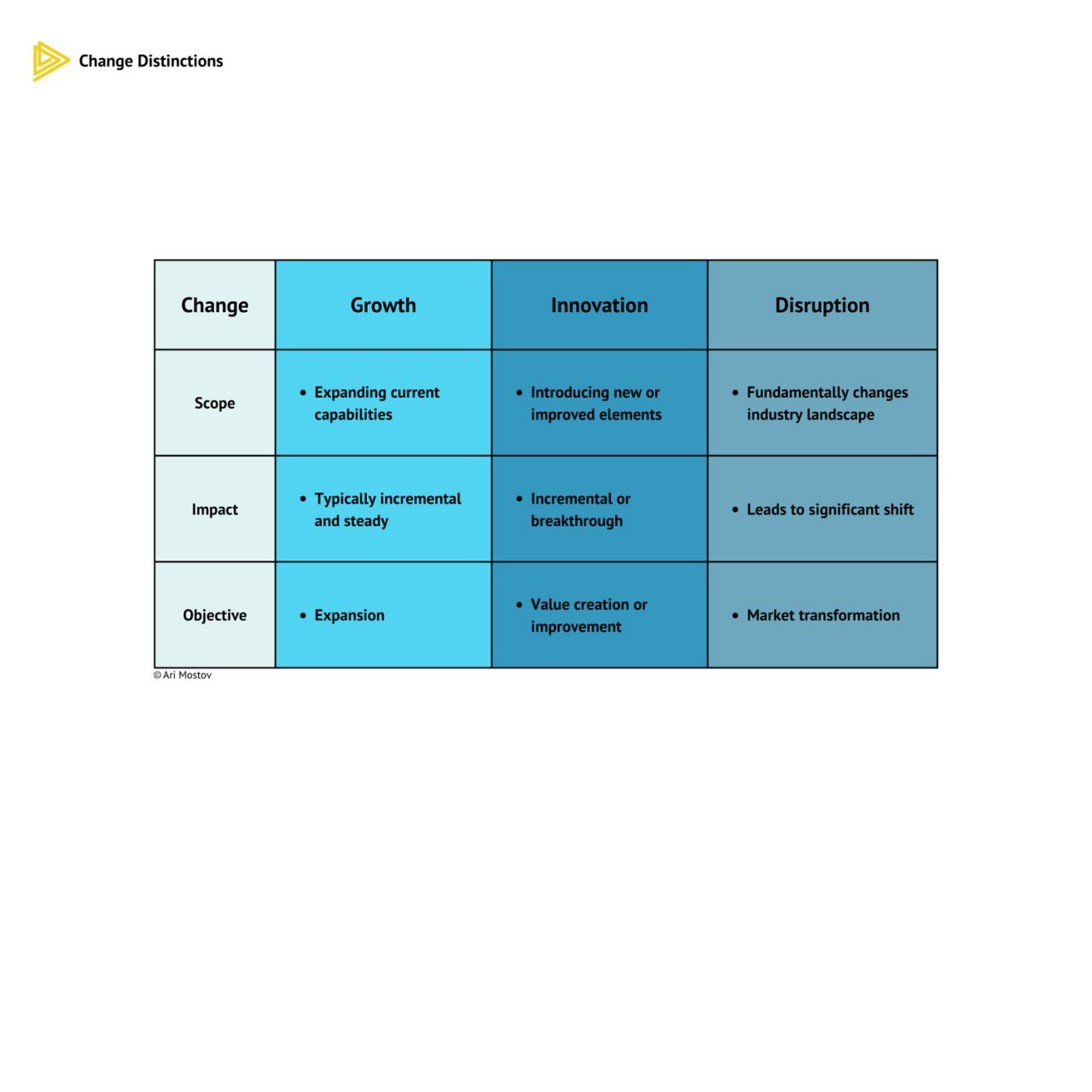
So, let’s start with the general category: CHANGE
Change is when something becomes different, altered or modified. In the words of Octavia Butler, “the only lasting truth is change.” Knowing what type of change you’re navigating is critical, especially when you’re communicating with others.
In business, we see three types of change:
1) Growth - an expansion of capabilities and capacities, often incremental and steady. This could be in revenue, market share, or even up-skilling your workforce. Growth is like budding flower🌷, healthy enough to reach the next phase in its life cycle.
2) Innovation - a discipline to develop new methods, products, processes and/or ideas. Historically, innovation was seen as the domain of research and development, but great ideas can come from anywhere. Innovation creates new value and improvements for stakeholders. It can be incremental or a complete breakthrough. If growth is like a budding flower, than innovation can be thought of as adding fertilizing earth worms to the soil 🪱.
3) Disruption - a change that fundamentally changes the status quo. A disruptive business can be the first one to bring an innovation to market (ex. OpenAI’s chatGPT) or we’ll often see legacy company’s responding to disruption with their own similar offerings (like Google’s gemini). If growth is a budding flower, innovation is fertilizing worms, then disruption is like climate change, forcing plants to adapt to a new normal 🌏.
More can be said about growth, innovation and disruption. But hopefully this is little graphic can help you navigate change.
Remember, “the only constant in life is change” - Heraclitus