

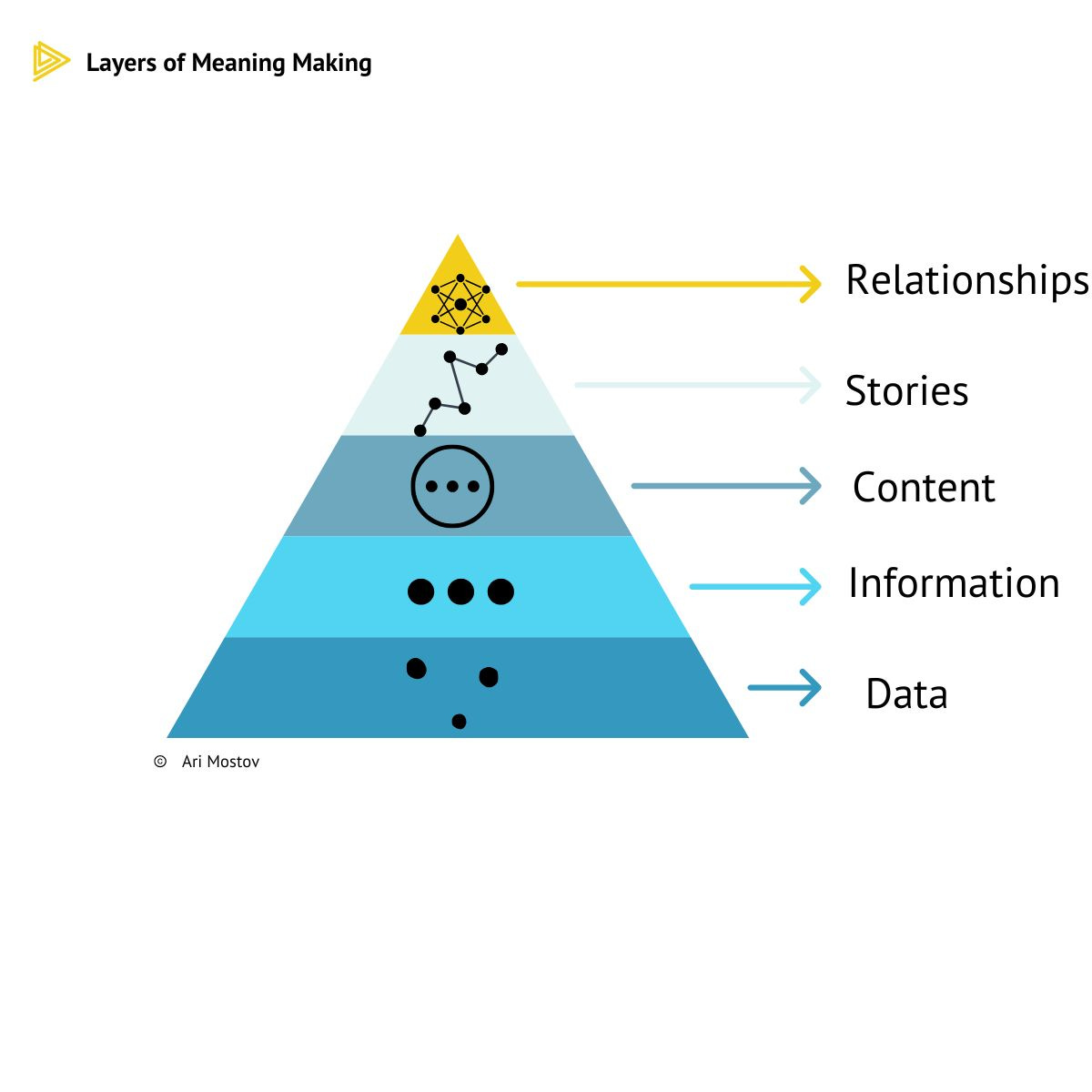
Narrative Strategy uses storytelling to deliver outcomes. But more than that, it uses storytelling to help individuals and collectives make meaning.
When I'm working with teams, we're often navigating through silos of data. This raw value doesn't necessarily mean anything, it has no context or lacks an orientation. With data, we can start to comb through the raw values and apply a lens -- a way to bring those silos into view and see the pieces as part of the whole. The processed data becomes information, adding a layer of significance to what once random values.
But information isn't always enough. Information is often ignored, not necessarily relevant to the moment at hand. So we create content, a way to contain and contextualize the information for a specific situation.
Yet, we're drowning in content. It's hard to find relevant content that understands your needs in particular. Content may help make sense of raw data and information, but if it doesn't catch your attention in the first 3 seconds, it won't make a difference.
This is where stories become essential. Storytelling is the original meaning making practice. Whether written, recited, watched or listened to, stories take that raw data, information and content and turn into an experience. It activates our senses, allowing us to imagine what's happening. It takes abstract data and gives it purpose.
But there's one more layer of meaning making we often forget.
Relationships.
Relationships are the interactions we have with one another. Our stories are exchanged with one another to create relationships, engendering us with more desire and understanding to be in each other's presence. Relationships are where we find meaning making at its highest form, able to give us grounding when everything seems lost.