

I was sent a job posting recently for Head of Strategic Communications and I was surprised by the role and responsibilities described in the JD. Most of the Head of Strategic Communications jobs I know of are focused on external affairs, an extension of the military heritage of “Strategic Communications” which focuses on propaganda, public perception, reputation and the like. But this job description read more like a posting for a narrative strategist and I was intrigued.
So let’s take a look at this job posting and see how it aligns with the functions of narrative strategy. I define narrative strategy as storytelling for outcomes - which has a lot of overlap with strategic communications. However, I use a systems approach to storytelling, designing and stewarding a narrative that engages, aligns and mobilizes all actors in the system.
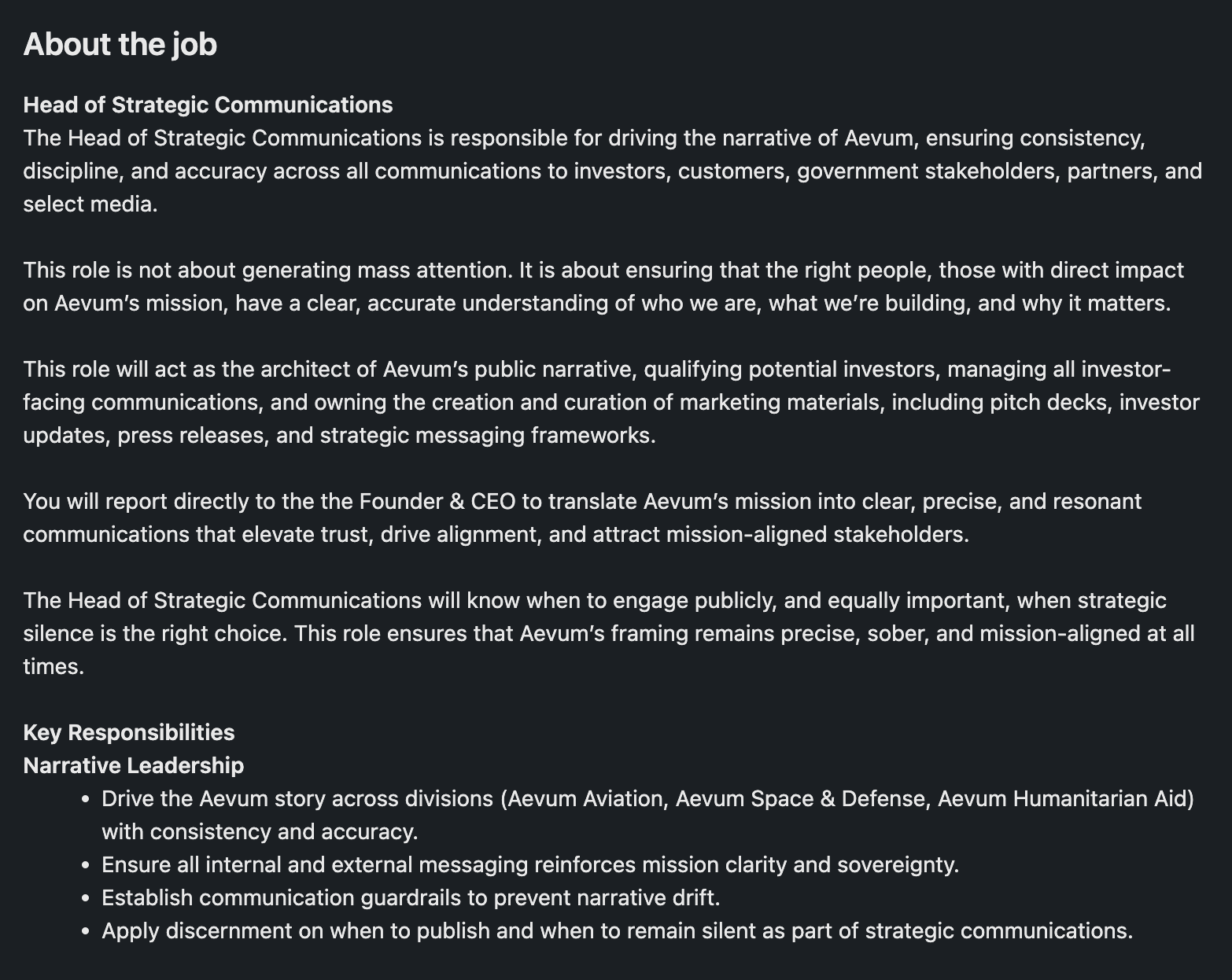
Ok, let’s start with the obvious. This is not a job for someone to generate a lot of attention and noise about a company. Many communication leaders are tasked with raising the company profile - think industry publications and events, thought leadership materials etc.
This role is not about generating mass attention. It is about ensuring that the right people, those with direct impact on Aevum’s mission, have a clear, accurate understanding of who we are, what we’re building, and why it matters.
But this is a unique detail of this JD stems from the industry it’s in: aerospace & defense. A complex, highly regulated sector where everything - including storytelling and communications — requires risk assessment and mitigation.
The language here reads more like a think tank report than a call for flashy publicists. Notice the the use of “sovereignty” and “narrative drift”. Terms that frame this company in terms of geopolitics, with the precision of an engineer.
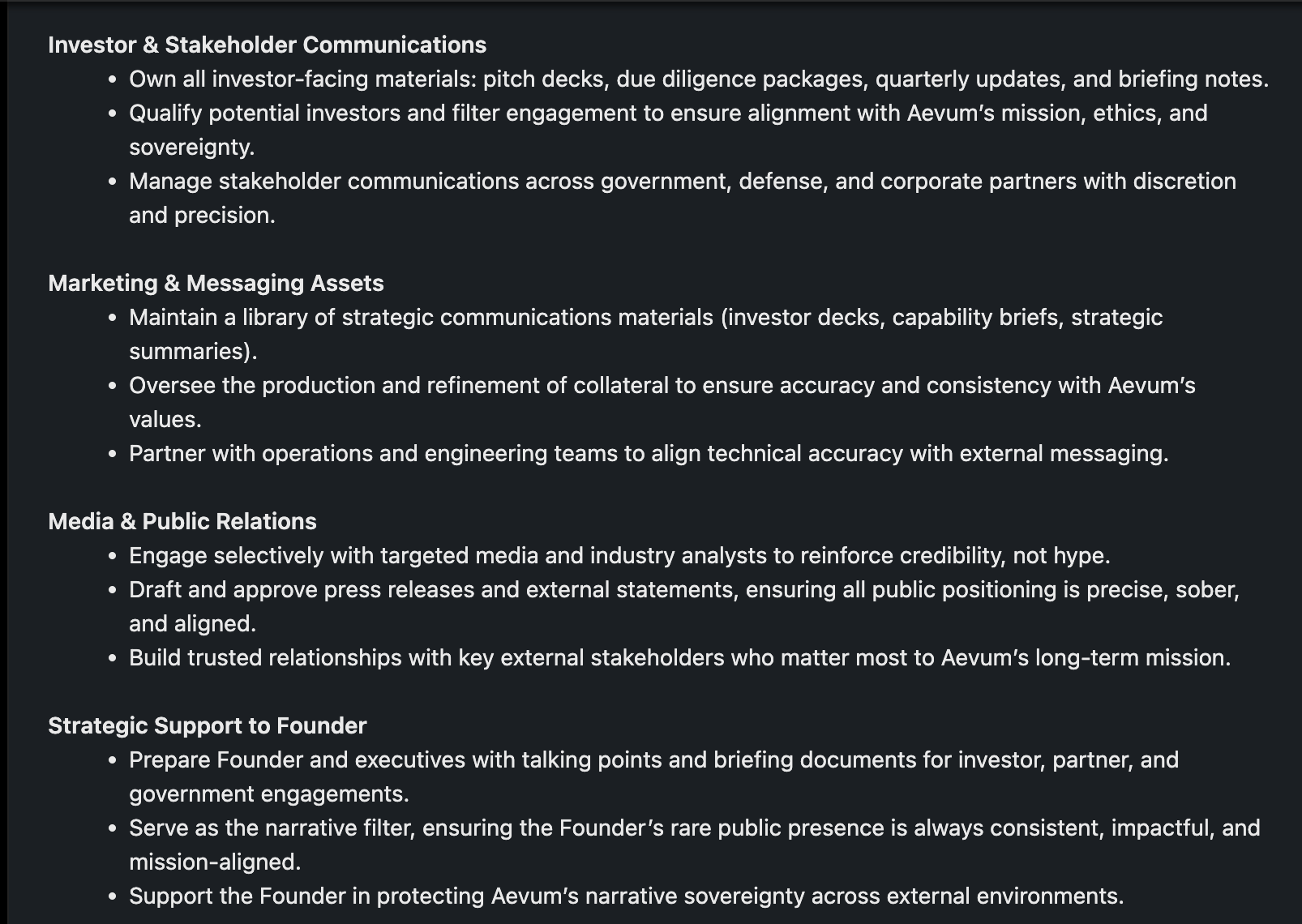
Also note how the responsibilities include communications & marketing - typically two different functions and roles entirely.
I distinguish communications and marketing based on the people involved. Marketing is for your customers and communications are for your partners. And the lines can easily get blurred in regulated industries. But for simplicity let’s think of it this way:
Communications: what you say to your team, your investors/funders, and any authority that has influence on your company’s ability to deliver its product. (regulatory bodies, governments, etc). AKA partners.
Marketing: what you say to the people who would use/buy your product. AKA customers.
Seeing the narrative responsibilities encompass not just marketing but also communications is encouraging. Often “narrative” gets siloed into PR or brand identity, rather than being used as the schema for company success and purpose. This JD reflects the state of the company - an early staged VC backed company with the trajectory to grow and thrive. The hiring team recognizes the significance of narrative strategy for company success.
I did not see responsibilities that explicitly include internal communications - AKA employee communications. This is also critical to a narrative strategist’s role, because internal communications are what enable the company to deliver outcomes. If your team doesn’t know how to talk and engage with one another to achieve their goals, you don’t have a team, you have a headache.
Internal communications are vital to company success, especially when working with so many stakeholders in a complex environment like aerospace & defense. Complexity demands clarity
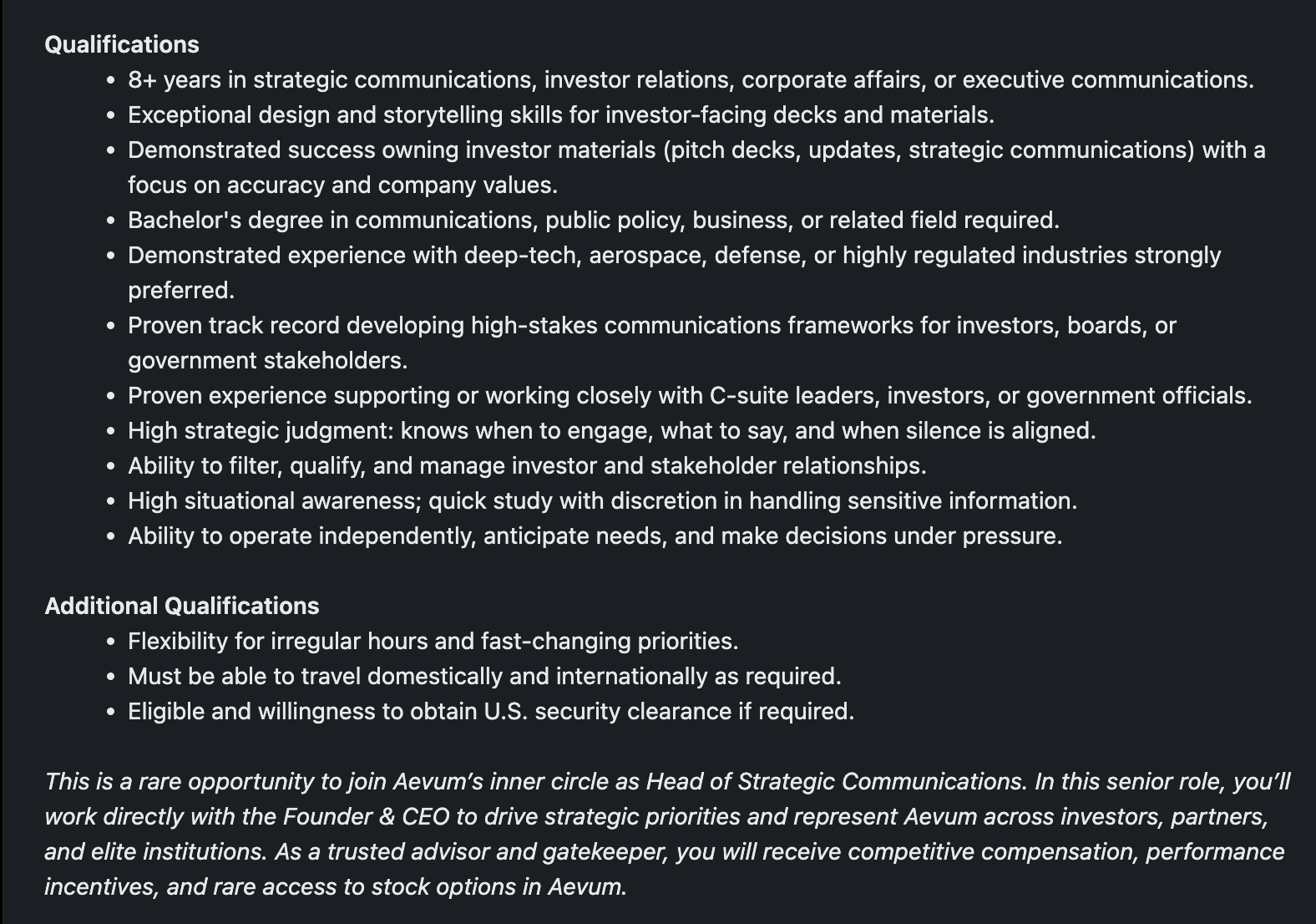
What is very explicit is the demand for investor communications. Which makes me think this company is about to raise or has a lot of investors they need to be in constant communication with.
And when you have a narrative, backed by a robust system of storytelling and communications, it’s a lot easier to get investors to believe in something that hasn’t been done before.
This is a unique JD for an aerospace & defense start up that recognizes the significance of communications and storytelling. I think the title of Head of Strategic Communications could easily translate into Narrative Strategist. However, narrative strategy doesn’t succeed unless the people working within the company are engaged and aligned. Internal storytelling and story-listening is necessary for individuals to come together and work as a team. Team members knowing their why, their what and their how is what delivers outcomes. As a narrative strategist, I spend just as much time crafting the external narrative assets as I do building the internal communications and storytelling capacity of the organization.
Narrative Strategy is an emergent field, one that I’ve been lucky enough to play in for over 7 years. It’s more than a thought exercise or fancy lingo for storytelling. It’s a job that needs to be done, a role that stewards a collective effort, and an opportunity to transform ideas into outcomes.