


I love seeing “Narrative Strategist” roles on the rise. Sometimes the roles use the term “Narrative Strategist” and other times it’s an amalgamation of “story” “communications”, “brand”, “strategy” and “narrative”, but with the same functionality that I would bundle under “Narrative Strategy”. Whenever I see a job posting that captures the role of narrative strategy, I must indulge in some good old fashion analysis. So, here’s another job posting breakdown from me to you - enjoy!
The Company: Field.AI

This start up is committed to creating something innovative that also works - not just novelty and hype. With language grounded in engineering and high standards, this company is committed to storytelling that acknowledges the present and identifies the the stakes of the future they’re creating. It’s not so much an aspirational story as a roadmap, what I would call a strategic narrative.
Quick call out - embodied intelligence is a category of AI focused on robots and machines. I’ve also seen it called “embodied AI” or “physical AI”. This isn’t another SaaS company or software darling — Field AI is building the machines that, until now, have only been read about in science fiction books.
The Role
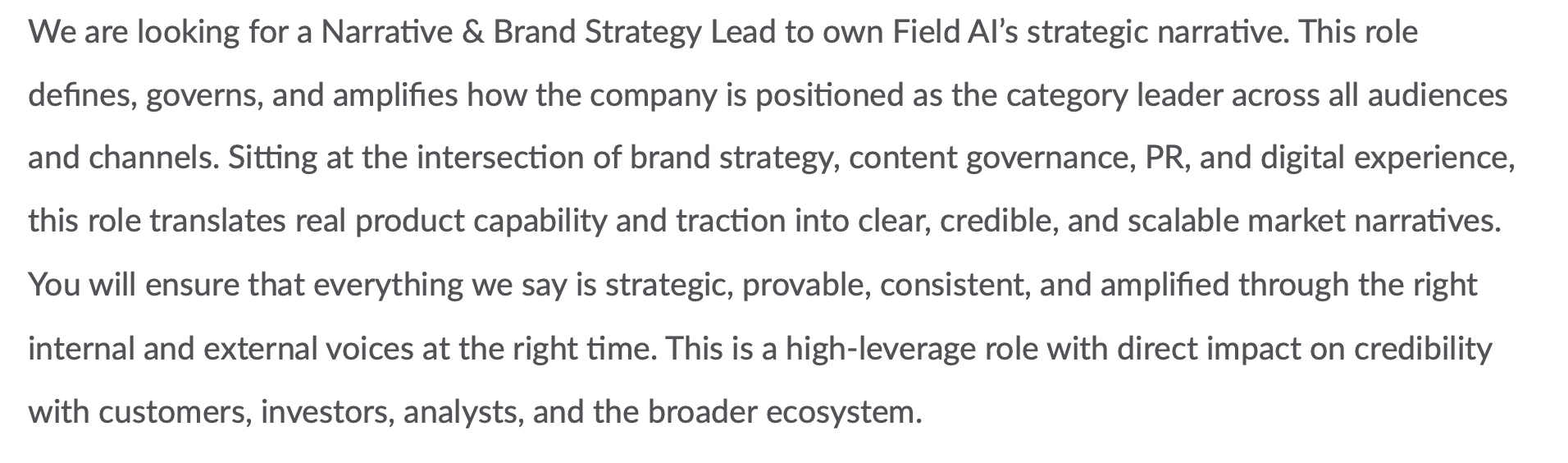
Oh my, this is just lovely. Mostly because this role describes a narrative strategist that has full 360 degree coverage of the narrative being stewarded. Narrative strategy works best when it’s leading across “all audiences and channels”. That means you’re stewarding the narrative not just from the C Suite (executive comms) or customer channels (marketing) — you’re championing the narrative across the whole business. When you have a systems level approach to storytelling, you’re able to identify how the language, story assets and communications are being used to achieve outcomes. Again, we’re seeing the emphasis on “credibility” and “governance” which speaks to high stakes, high responsibility environments that Field AI is likely operating in, such as energy, government response. The narrative needs for a company like Field AI are far more demanding than a typical B2C company, as the risks of miscommunications and misunderstanding can compound into serious adverse outcomes. Each communication, each story asset, is crafted and shared with astute attention and forethought — there’s no glib social media comments or off the cuff hot-mic moments. Field AI’s narrative is treated as mission-critical for it’s success.
The Details
This is where we see the many faces of narrative strategy come out and play. Narrative strategist are not one trick ponies. We’re cross-functional, multi-hyphenates that works across the business and product lifecycle. This specific list of tasks leans heavily on communications and messaging management, which is critical to narrative strategy success. And, I do see signals that this role would be partnering and mobilizing other stakeholders, which I believe is one of the biggest responsibilities of narrative strategy.
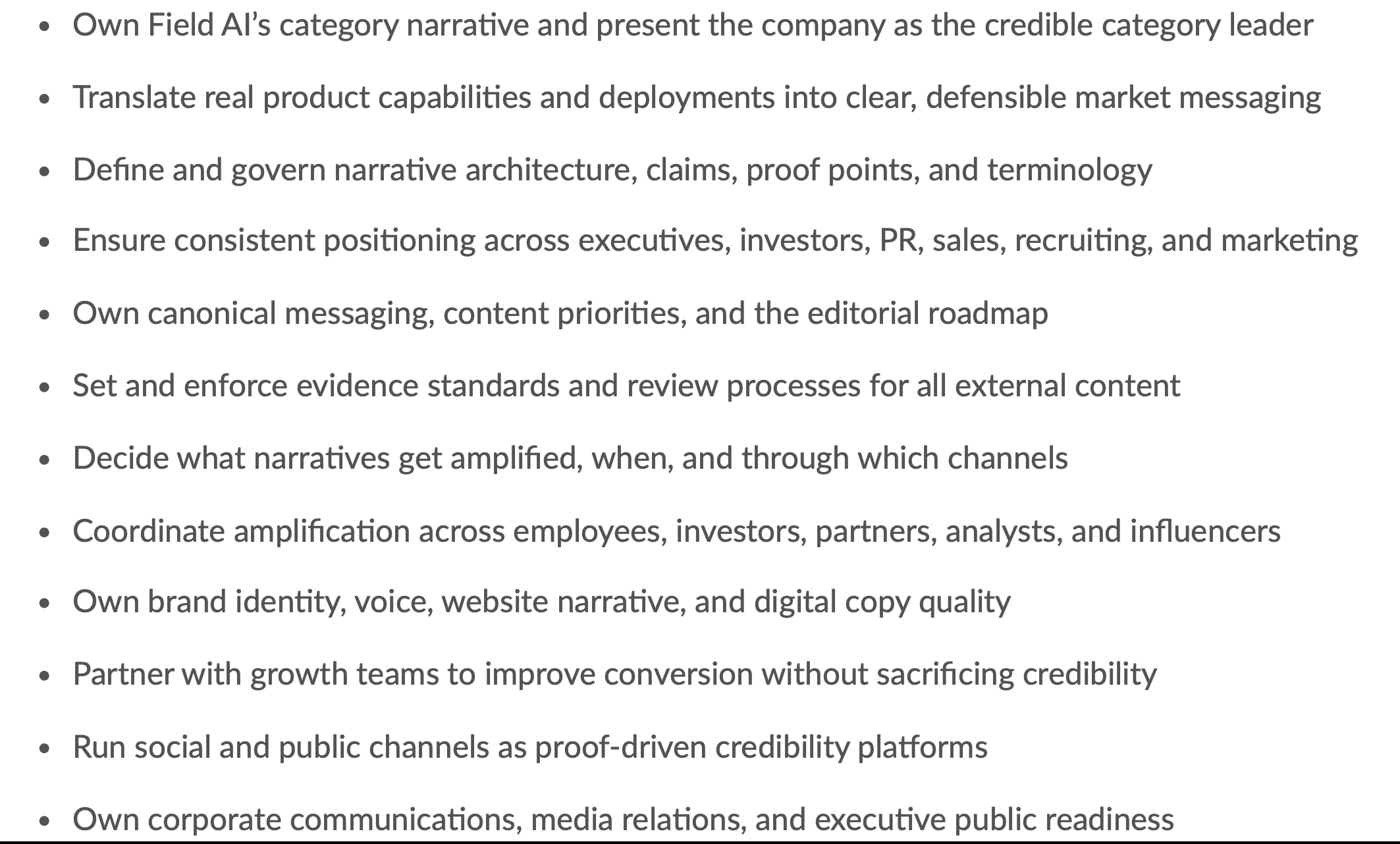
Slight tangent: Stakeholder engagement can be likened to putting on a play. We’re all players and we need to be ready to perform on opening night. As a narrative strategist, I’m both playwright, director and dramaturge. I need my actors - the stakeholders - to play their part and play it well. I also need them to understand why their part matters and why we’re putting on this play in the first place. They need to connect to the story, understand the “why” behind it, and perform well enough that we win a Tony.
Narrative strategists are more than just competent copywriters or corporate communicators, we are relationship professionals. We use storytelling to understand and motivate, create the contexts needed for people to achieve successful outcomes. We use story to coordinate the messy parts of human perception and experience, so we can work better together. It’s one part group therapy, one part vision quest and all parts leadership.
This is just the beginning
Narrative strategy is still an emergent field, yet the demand for practitioners is seriously affirming. We can nerd out on all the academic rigor and discourse that goes into narrative strategy, but the real proof is what it delivers in the market. With companies like Field AI building the future, narrative strategy is more critical now than ever. I firmly believe that we craft our futures through the stories we tell. The stories we tell in organizations and other collective spaces is where we’ll see the real future building come to fruition.
Time to get crafting.
Great insight! I'm looking forward to more people (especially in corporate environments) realizing the value of Narrative Strategy, and being open to using it to make the world a better place :)