
Narrative Strategy: Commercialization Infrastructure

A lot of commercialization work gets treated like a project management exercise.
Build the roadmap. Define the milestones. Assign owners. Track progress. Keep everyone moving.
And to be clear, I love a good project plan. Without one, even the best idea dissolves into vibes and recurring meetings. But in my work with innovation teams, especially teams bringing complex products, platforms, and strategic initiatives to market, I’ve noticed something that keeps showing up: the roadmap may be clear, but the reason for the work is not.
Or at least, it is not clear enough to travel.
People know what they are supposed to do. They know the next meeting, the next asset, the next deadline. But they do not always know how the project connects to the larger direction of the company. They do not know why this initiative deserves attention over the dozen other urgent priorities on their plate. They do not know how to explain why it matters without pulling someone from leadership into the room.
That is usually where commercialization starts to wobble.
Not because the product is weak. Not because the market opportunity is fake. Not because the team is incompetent. Most of the time, the problem is much more ordinary and much more dangerous: the story has not made it from the vision to the people responsible for carrying it.
And when the story does not travel, alignment breaks.
Commercialization is not separate from corporate vision
Commercialization is usually described as the process of bringing an innovation to market. That is true, but it is also incomplete.
Inside an organization, commercialization is not just about getting something to market. It is about getting the organization to move toward the market in a coordinated way.
That distinction matters.
A commercialization project has to make sense in relationship to the company’s larger vision and goals. Otherwise, it becomes another initiative competing for budget, attention, leadership support, and organizational energy. It may be strategically important, but if people cannot see how it fits, it starts to feel optional.
I have seen this most clearly in high-complexity environments: healthcare & life sciences, frontier technology, regulated markets, and other places where the thing being built is not immediately self-explanatory.
In these environments, innovation does not simply “launch.” It has to be interpreted over and over again.
Leadership needs to understand the strategic value. Product needs to understand what is being built and why. Sales needs to know how to position it without overpromising. Marketing needs to know what claims are credible. Regulatory, clinical, legal, or technical stakeholders may need to know where the boundaries are. Customers need to understand why they should care. Partners need to understand where they fit.
That is not just a communications challenge. It is a commercialization challenge.
Because if each group interprets the work differently, the organization is not really moving together. It is just moving at the same time.
Vision is the center, not the poster on the wall
There is a very corporate way of talking about vision that makes the whole thing feel useless.
A sentence on a slide. A polished leadership statement. A line on the website. A paragraph in an annual report. Something everyone vaguely recognizes, but almost no one uses to make a real decision.
That is not the kind of vision I mean.
In commercialization, vision has to do work. It has to help people answer practical questions: Does this project matter? Why this product? Why this market? Why now? What tradeoffs are we willing to make? What resources should this receive? What does success actually look like?
This is where narrative strategy becomes useful.
A good narrative does not just describe the vision in nicer language. It makes the vision usable. It gives people a way to connect the big strategic idea to the everyday decisions they have to make.
Because the real test of a vision is not whether executives can repeat it at an all-hands. The real test is whether teams can use it when the room gets messy.
When the customer pushes back. When sales asks for a sharper claim. When product has to make a roadmap tradeoff. When marketing is staring at a blank page. When leadership has to decide whether this initiative deserves more resources or less patience.
That is when you find out whether the vision is alive or just laminated.
The commercialization alignment stack
This is the basic model I keep coming back to: vision sits at the center. Communications translate the vision. The project plan organizes the work. Functions execute the work. Alignment is what keeps those layers connected.
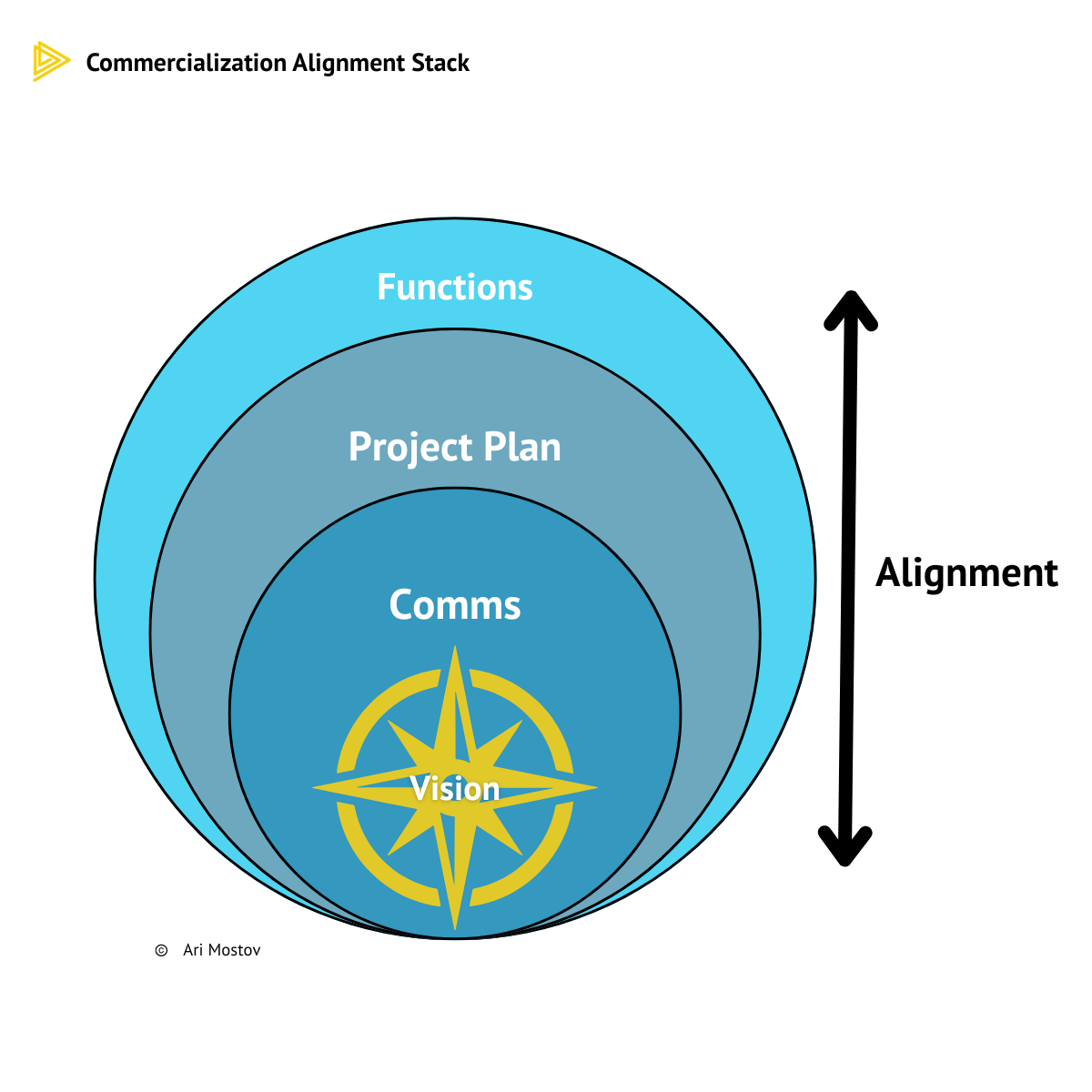
Vision sits at the center, but it only becomes useful when it travels outward through communications, project planning, and functional execution. Alignment is not a one-time agreement. It is the connective force that keeps each layer oriented toward the same strategic direction.
When the vision is clear, communications have something real to carry. When communications are clear, the project plan has strategic logic. When the project plan is clear, functions understand their role in the larger effort. And when functions understand their role, the organization can actually move.
But when those layers disconnect, the symptoms are familiar.
Product is building one story. Marketing is telling another. Sales is making it up in the field because they have to. Leadership is still describing the opportunity in broad, aspirational terms. Customers are hearing benefits but not urgency. Internal teams are doing the work, but they do not really know what game they are playing.
And then the launch feels slow, fragmented, or strangely underpowered.
Everyone is busy. Everyone is working. But the work is not compounding.
That is usually a narrative transmission problem.
The real narrative work happens before the writing
In client work, I often find that the most important narrative work happens before anything gets written.
It happens in the conversations where people finally say the quiet part out loud:
How are we positioning this?
Is this a revenue play, a strategic wedge, a transformation initiative, a category move, or some uncomfortable combination of all of the above?
Are we trying to drive adoption, secure investment, shift perception, build trust, defend the strategy, or help the field sell?
What does leadership believe this unlocks?
What does the customer need to believe before they can act?
What does the field actually need in order to explain this without flattening it?
These questions can look basic from the outside. They are not. They are usually where the whole commercialization effort either starts to cohere or starts to quietly fracture.
Because once a team has to connect the project back to the larger organizational vision, vague alignment is not enough. People have to clarify assumptions. They have to define the real stakes. They have to explain why the project matters to the business, why it deserves resources, and what must be true for it to succeed.
That process is not administrative. It is mobilizing.
This is one of the most under-appreciated parts of narrative strategy. Narrative is not just the language you use after the strategy is done. Narrative is the work of creating enough shared meaning for people to act together.
Clarity makes the ask easier to support
Commercialization projects need resources. Money, yes, but also time, talent, executive attention, cross-functional support, and patience.
And whether people admit it or not, resource allocation is always shaped by narrative.
I have seen strong projects struggle because the story was not yet strong enough to carry the ask. The initiative mattered, but it sounded optional.
That is where narrative work becomes very concrete.
The projects that are easier to understand are easier to support. The projects connected to clear goals are easier to defend. The projects that tie directly to the company’s vision are easier to prioritize.
This does not mean every commercialization narrative has to become a financial model in paragraph form. Sometimes the goal is revenue. Sometimes it is market penetration. Sometimes it is customer loyalty, repeat sales, category leadership, clinical adoption, operational resilience, or strategic positioning.
But whatever the goal is, the story has to make it legible.
Without that clarity, functions start optimizing for different things. Product optimizes for technical elegance. Sales optimizes for what gets a meeting. Marketing optimizes for what sounds clean. Legal optimizes for risk reduction. Leadership optimizes for strategic optionality.
None of those instincts are wrong. In fact, they are usually rational within each function. But if they are not governed by a shared vision, they can work against each other without anyone meaning to create conflict.
That is how commercialization gets expensive.
The story has to survive handoffs
This is the part I care about most: commercialization does not happen in one room.
It happens through handoffs.
Leadership to product. Product to marketing. Marketing to sales. Sales to customers. Customers back to product. Partners back to leadership. Field teams back to strategy.
At every handoff, the story can either get stronger or degrade.
I have watched this happen in real time. A strategic narrative that feels sharp in the executive room becomes generic by the time it reaches the website. A smart positioning decision gets diluted in a sales deck. A powerful customer insight gets flattened into a claim no one quite believes. A transformational initiative gets translated into internal jargon. A market-making opportunity gets reduced to “new feature” language because that is what the existing system knows how to process.
This is why alignment cannot just mean everyone liked the kickoff deck.
Alignment has to mean the narrative is durable enough to travel.
Can the sales team explain it without the founder in the room? Can marketing turn it into credible claims? Can product use it to make roadmap tradeoffs? Can executives use it to defend investment? Can customers repeat the value in their own words? Can partners understand where they fit?
That is the real test.
Not whether the narrative sounds good.
Whether it moves.
Commercialization needs a narrative system
Narrative strategy is not just a communications layer. It is part of the commercialization infrastructure.
Commercialization needs more than a product story. It needs a narrative system that connects corporate vision, strategic goals, project objectives, functional roles, market opportunity, customer value, resource decisions, execution priorities, and feedback loops. In my work, it looks like a narrative bible that acts as a living guide for stakeholders across the organization.
Without that system, organizations often default to more activity.But more communication does not automatically create more clarity. Sometimes it just creates more noise. Narrative strategy helps make sure the communication is carrying the right signal.
So before asking, “How do we launch this?” it may be worth asking a more uncomfortable question:
Can everyone explain how this commercialization project advances the vision?
Not vaguely. Not aspirationally. Not with corporate fog. Clearly.
Because if the answer is no, the project may still move. But it will move with drag. And in complex organizations, drag is expensive. It costs time, trust, resources, and market momentum.
That is why narrative matters. Not because innovation needs prettier language. Because innovation needs alignment that can survive the journey from vision to market.
Footnote: This piece is informed by my work with innovation, commercialization, and transformation teams, with supporting reference to Jerry Schaufeld’s Commercializing Innovation: Turning Technology Breakthroughs into Products (Apress, 2015), especially his discussion of corporate vision, commercialization decision-making, resource allocation, and dynamic feedback between project goals and enterprise vision.