

Story versus Narrative — What’s the Difference?
In organizations, the term “story” and “narrative” are often used interchangeably, but they are distinct concepts. A story, like history, has a clear beginning, middle, and end. It’s a series of events that
have already occurred, and while there can be stories happening in the present, the essence of “storytelling” lies in sharing events with
identifiable timelines.
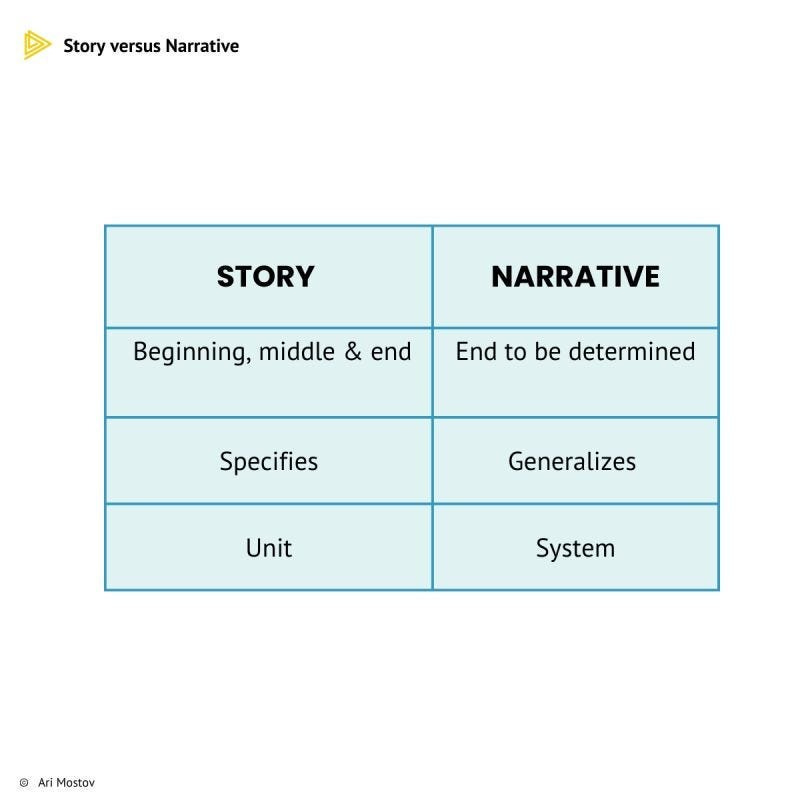
Narrative, on the other hand, lacks a predetermined ending. It encompasses both the present and the future, with the future yet to unfold. Narratives are continually evolving and perpetuated, shaped by the stories we tell. A narrative is a system of stories. Imagine a forest composed of many trees. Each story is a tree, a unit, playing its part to build the larger narrative that is the forest. When you’re within the forest of narrative, you’re surrounded by countless stories, each playing a unique role. Stepping outside, you gain perspective on the overarching narrative that encompasses them all, like viewing the entire forest from a distance.
Finding Direction — The North Star Narrative
While stories are the building blocks of narrative, giving us an understanding of what has already happened, it’s possible to use storytelling to guide us through the future. All we need is a North Star. In Mongolian mythology, the North Star is revered as the steadfast
peg that anchors our world. Ancient explorers depended on this celestial compass for guidance as they ventured into the unknown.
Today, organizations can harness the power of the North Star to navigate change and uncertainty, while boldly moving towards the future.
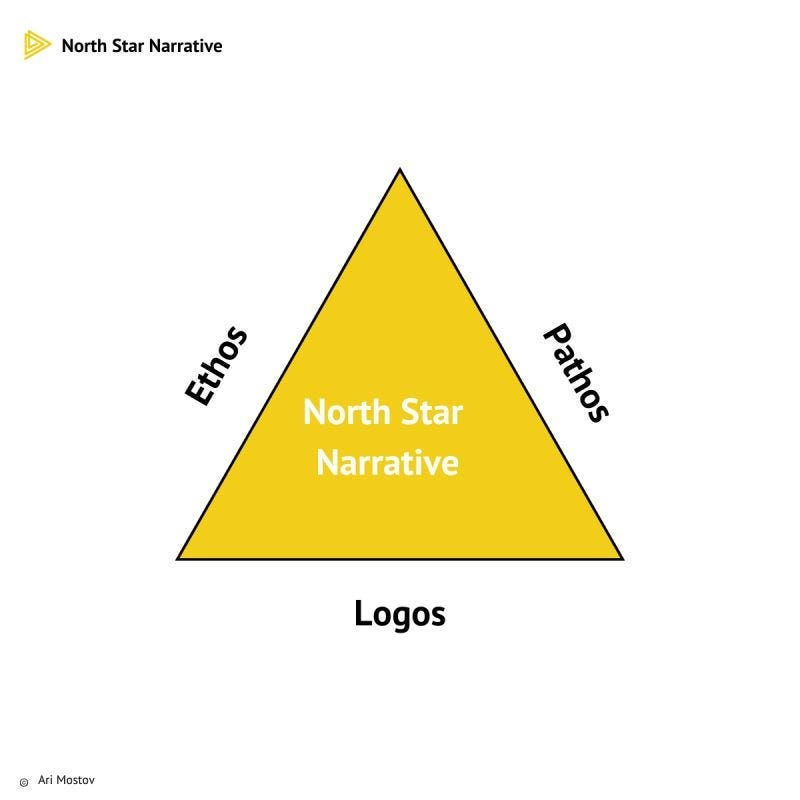
The North Star Narrative provides compelling and inspiring prose, reshaping the organization’s vision, mission, and values into a clear purpose and unwavering intent. Drawing from Aristotle’s timeless rhetoric –ethos for ‘credibility,’ pathos for ‘emotion,’ and logos for ‘logic’ — the North Star Narrative becomes the guiding force. It empowers every member of the organization to identify their current position, chart their future course, and comprehend the ‘why’ behind it all. Even as landscapes shift and obstacles arise, the organization will rely on its North Star Narrative to illuminate the path through disruption.
Mobilizing with Narrative Strategy
When disruption occurs or the future is uncertain, even high performing teams struggle to find their way forward. Enter Narrative Strategy — the art and science of storytelling to achieve desired outcomes.
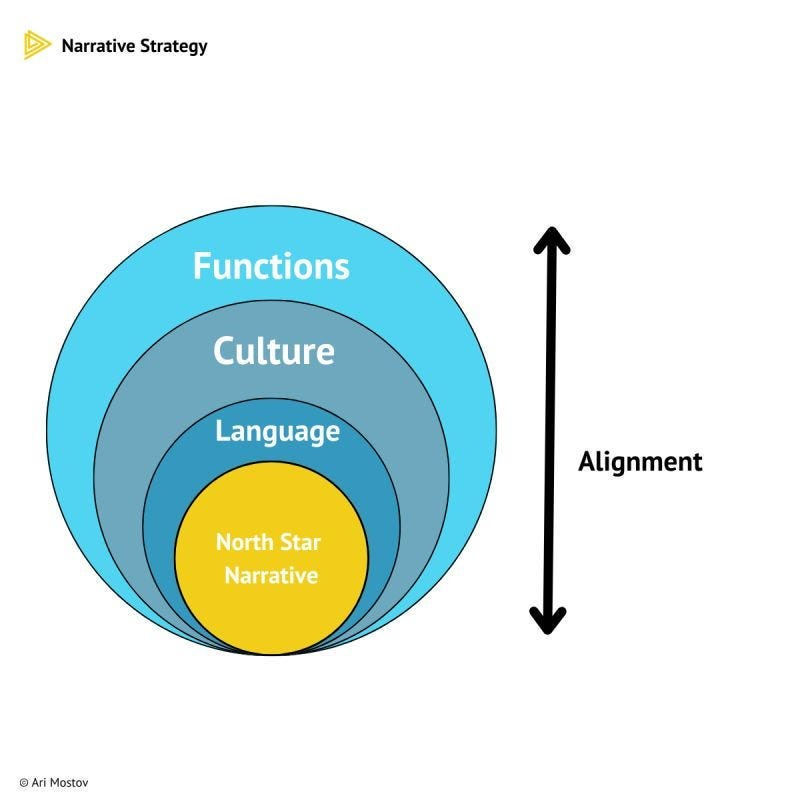
Narrative Strategy possesses the remarkable ability to mobilize large
organizations. In these complex settings, individuals often grapple with understanding their purpose and direction within the broader context. They don’t know what story they’re in and where they are heading. When an organization embraces Narrative Strategy, its language, culture, and functions all converge around the shared North Star Narrative. Like the score of a symphony, the North Star Narrative enables each individual to find their place within the composition.
A Compass for Disruption
As organizations navigate increasing complexity, they will need strategies that help all stakeholders find clarity. With narrative strategy, organizations are able to handle uncertainty with resilience and composure. No matter the situation or context, the organization will always have its North Star, finding their way forward with narrative strategy as their compass.