

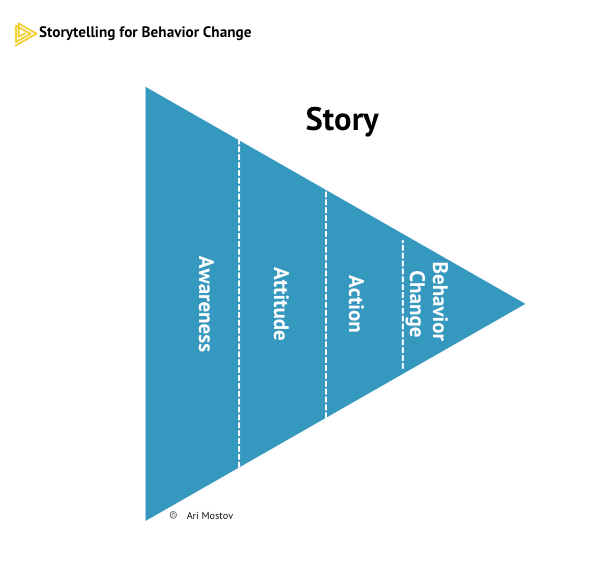
Awareness → Attitude → Action → Behavior Change
Storytelling isn't just about sharing information — it's about transformation.
I’ve worked with organizations tackling some of the world’s hardest challenges: improving public health, combating sexual violence, scaling new technologies. Again and again, I return to this simple truth:
Facts inform. Stories move.
This diagram is one I keep coming back to. It captures the arc of how change actually happens:
Awareness: “I didn’t know.”
Attitude: “Now that I know, I care.”
Action: “Because I care, I’ll do something.”
Behavior Change: “This is who I am now.”
The role of storytelling is to carry people through this funnel.
It gives audiences a reason to care, a sense of what’s possible, and the belief that they can act. And most importantly, it sustains the change.
🚨 In healthcare, for example, patient education campaigns fail when they focus only on awareness. But stories — real, human, emotional stories — are what shift attitudes, drive action, and support long-term adherence.
If you're trying to spark change in your organization or sector, ask yourself:
👉 Are you just informing people?
👉 Or are you inviting them on a journey?