
Narrative Stategy: The Product Isn’t Always the Problem. Sometimes the Story Doesn’t Travel.
Commercialization is supposed to move innovation from idea to adoption. Narrative is what keeps that movement from falling apart.

We love to talk about commercialization like it’s a clean process.
First, you have the idea. Then you recognize the opportunity. Then you test feasibility. Then you figure out go-to-market. Then you make a project plan and execute.
Lovely. Linear. Sensible.
Except humans are involved, which means everything immediately gets more complicated.
At every step, people have to understand the work. They have to interpret it, believe in it, fund it, sell it, approve it, adopt it, repeat it, or defend it in a meeting where you are not present. Which means commercialization is not just a product process. It is not just a business process. It is also a narrative process.
And this is where a lot of strong products get into trouble.
Most innovation does not fail because the product is weak. It fails because the story does not travel.
The executive team sees one version of the opportunity. Product sees another. Sales hears something different. Marketing turns it into generic language because no one gave them a better frame. Partners do not know how to explain it. Customers cannot tell whether this is urgent, useful, or just another shiny thing.
Everyone is technically talking about the same product. They are just not telling the same story.
Commercialization needs a through-line
This is the commercialization process I keep coming back to. Not because it captures every nuance, but because it captures the basic movement:
idea → opportunity recognition → feasibility analysis → go-to-market methods → project plan
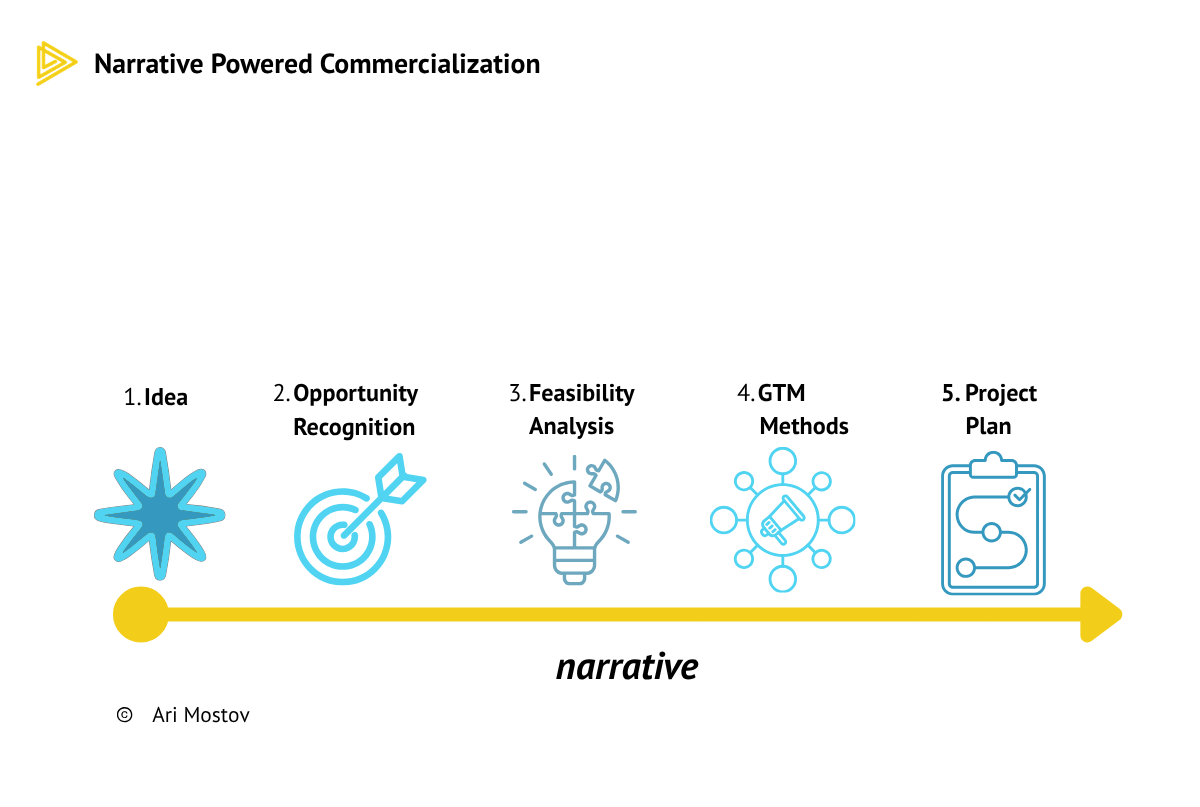
And what I would add is the yellow line underneath it all: narrative.
Narrative is the through-line that helps innovation move from idea to adoption without losing coherence. The stages are the commercialization process. The line is narrative.
Not a tagline. Not a campaign. Not the “pretty words” added at the end once the serious strategy work is finished. Narrative is the thing that helps the work keep making sense as it moves.
It gives people a way to understand what is being built, why it matters, who it is for, why now, and what needs to happen next. It keeps the meaning intact as the work moves from one function to another, one audience to another, one phase to another.
Without that through-line, commercialization becomes a sequence of disconnected activities. With it, commercialization becomes coordinated movement.
Stages of Commercialization
1. Idea stage - narrative gives the work shape
At the beginning, an idea is often fragile. It may be a technology, a capability, an insight, a research finding, a prototype, or a strange little spark someone cannot stop thinking about.
At this stage, narrative helps answer the earliest questions:
What is this?
Why does it matter?
What problem are we seeing?
Why is this worth exploring?
Without narrative, an idea can look random. Interesting, maybe. Clever, perhaps. But not necessarily important. With narrative, the idea starts to become a direction.
This does not mean over-selling it before it is ready. It means giving the idea enough shape that other people can understand why it deserves attention.
A good early narrative does not pretend to have all the answers. It creates a frame for better questions.
2. Opportunity Recognition -narrative turns “interesting” into “important”
Opportunity recognition is where the idea starts connecting to a larger opening.
This is where you begin to ask:
Why now?
Who needs this?
What shift makes this possible or necessary?
What pain does this actually speak to?
What is changing in the market, the technology, the customer behavior, the policy environment, or the organization that makes this worth pursuing?
This is where “interesting” has to become “important.” And that shift does not happen automatically.
People may understand the feature but miss the opportunity. They may see the technical elegance but not the commercial relevance. They may admire the novelty while failing to see why anyone should act.
Narrative connects the thing being built to the world it is entering. It helps people see the opening.
3. Feasibility Analysis - narrative keeps evaluation from fragmenting
This is where narrative work gets underestimated.
Feasibility sounds like it should be purely analytical. Can we build it? Can it work? Can we afford it? Can we scale it?
Yes. Obviously.
But feasibility is rarely only technical.
It may also be organizational, regulatory, financial, operational, behavioral, clinical, commercial, or political. Different stakeholders evaluate feasibility through different lenses because they are responsible for different risks.
The technical team may be asking, “Can this be built?”
The commercial team may be asking, “Can this be sold?”
Legal or regulatory may be asking, “Can this be claimed?”
Operations may be asking, “Can this be implemented?”
Leadership may be asking, “Is this worth prioritizing?”
None of those questions are wrong. But if every function is evaluating the opportunity from a different story, the feasibility conversation gets messy fast.
Narrative creates a shared frame. It does not flatten complexity. It organizes it.
It helps people understand what success looks like, what assumptions matter, what risk is acceptable, what evidence is needed, and what decision is actually being made.
Without that shared frame, a viable product can still stall because the organization cannot agree on what it is looking at.
4. Go-to-market - where weak narrative becomes very expensive
Go-to-market is the phase people usually associate with messaging. This is where positioning, sales narratives, launch messaging, buyer strategy, partner communications, and market education become more visible.
But by this point, the narrative should not be starting from scratch. If you wait until go-to-market to figure out the story, you are already late.
Narrative helps clarify:
Who is this for?
What category does it belong in?
What makes it different?
Why should the buyer care?
Why should adoption happen now?
What belief needs to shift for this to make sense?
When the narrative is weak, go-to-market gets expensive quickly.
Sales improvises.
Marketing generalizes.
Product overexplains.
Leadership keeps rewriting the pitch.
Partners carry the wrong message.
The buyer gets confused.
And confusion is not a small problem. Confusion slows momentum. It creates hesitation. It gives people a reason to wait.
A strong go-to-market narrative does not just make the product sound good. It makes the product easier to understand, trust, evaluate, and act on.
5. Project plan stage - narrative keeps execution from becoming a pile of tasks
A project plan is necessary.
I love a good plan. Give me the timeline, owners, workstreams, dependencies, milestones, risks, and next steps. Please and thank you.
But a project plan alone does not create alignment. A project plan tells people what to do. A narrative reminds them what the work is moving toward.
This matters because execution is where strategic intent often gets diluted. The work gets handed off. Teams get busy. Priorities shift. People start optimizing for their piece of the process. The original meaning begins to blur.
Narrative helps sustain coherence through execution.
It helps teams understand not just their tasks, but their role in the larger movement. It keeps the purpose, the stakes, and the desired outcome visible as the work becomes operational.
Without narrative, execution can become wasteful activity. With narrative, execution has direction.
Narrative is commercialization infrastructure
This is the real point. Narrative is not the decoration on top of commercialization. It is part of the infrastructure that helps commercialization work.
Commercialization depends on coordinated action. Coordinated action depends on shared understanding. Shared understanding depends on narrative.
This is especially true when the product is complex, the category is emerging, or the market does not yet have language for what you are building.
In complex, highly technical markets, the product may be technically impressive and still difficult to explain, evaluate, trust, or adopt.
That is not a minor communications issue. That is a commercialization issue.
Because if the story breaks, the commercialization process starts to break with it.
How to know the story is not traveling
Here are some signs.
Different teams describe the product differently.
Sales needs a founder, executive, or technical lead in every important conversation.
Marketing keeps using generic claims.
Customers understand the feature but not the value.
Partners cannot explain where the product fits.
Leadership agrees in the room, but alignment disappears after the meeting.
The launch keeps stalling in “almost.”
The product sounds compelling in one person’s mouth and confusing everywhere else.
That last one matters. If your product only makes sense when one specific person explains it, you do not have a narrative system yet.
You have a dependency. And dependencies do not scale.
The story has to be strong enough to carry the product
Strong products matter. Of course they do. The product has to work. The science has to be real. The technology has to be defensible. The customer need has to exist. The business model has to make sense.
But commercialization asks more of a product than technical strength.
It asks the product to move across teams, markets, buyers, partners, policies, incentives, existing beliefs, and organizational systems.
That movement needs force.That force is narrative.
Not narrative as spin. Not narrative as fluff. Not narrative as a clever phrase you put on a landing page and forget about. Narrative as the shared structure of meaning that helps people understand what is happening, why it matters, and what action to take next.
The strongest innovations do not move on technical merit alone.
They move when the story is strong enough to travel.
Need the story to travel?
I help innovation leaders turn complex products, platforms, and strategic initiatives into clear narratives that drive alignment, adoption, and commercial momentum.
Reach out about narrative strategy sprints, advisory support, or workshops for innovation and commercialization teams.
Great points about when the story is failing at "different teams describe the product differently". This is so critical and often not recognised as an issue as it is happening. But as you call out, it confuses, and if potential clients or customers are interacting with different stories, they very quickly put it all in the too-hard basket.